
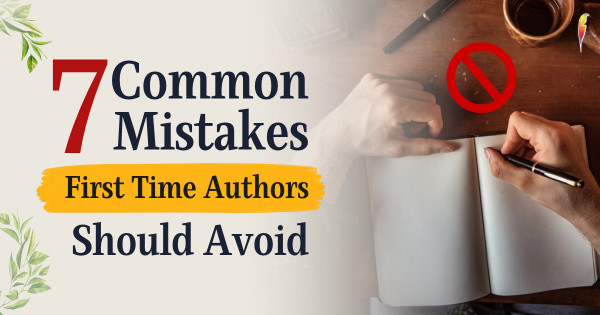
7 Common Mistakes First-Time Authors Should Avoid
You may have spent years teaching, running a business, raising a family, or working in a field you know inside out. Or perhaps you've had a story idea in your head for as long as you can remember. Either way, you've started wondering “could I write a book?”
You don't need to be a professional writer to begin. But having a good idea and turning it into a book people enjoy reading are different things.
According to a 2026 Pew Research Center report, 75% of U.S. adults had read at least part of a book in the previous 12 months. For new authors, the challenge is giving those readers a reason to keep turning the pages.
Before you begin your first book, let's look at seven of the most common mistakes new authors make and how to avoid them.
1. Thinking About Publishing Before Finishing Your Book
It's easy to get excited about seeing your name on a cover. You might start looking for publishers, planning book signings, or wondering what your book will cost before even writing the first word of your manuscript.
But those decisions can wait. Without a complete manuscript, you can't tell whether your ideas work as a full book.
How to avoid it: Start with a simple chapter outline. Decide what your book will cover, then focus on finishing a first draft. Leave major publishing decisions until you've revised the manuscript.
If you're unsure how to begin, Austin Macauley's guide to starting a writing project offers some practical tips to get started.
2. Editing Without Outside Feedback
You know what you mean when you write a sentence. A new reader doesn't. That's why you might miss confusing explanations, repeated information, or characters whose actions don't make sense.
Editing involves more than checking spelling or removing extra words. First, you need to check that the story or ideas make sense. Only then should you focus on sentence-level errors. Many common writing mistakes only become clear when someone else reads your work.
How to avoid it: After completing your first draft, leave it alone for a short while. Read it again and ask two or three trusted readers for honest feedback. A writing group or professional editor can help you spot bigger problems. Then proofread carefully.
You can use Austin Macauley's self-editing guide to build a simple revision checklist.
3. Starting With Too Much Background Information
New writers sometimes try to explain everything at once: where the story happens, who the characters are, and what happened years ago.
But an opening chapter packed with history can feel slow.
Imagine opening a mystery with three pages about a family's past. Now imagine opening with a missing person or a letter from someone who died years ago. You get the idea. The second version gives readers something to wonder about.
How to avoid it: Begin with an interesting moment, question, or problem. Share background details when readers need them. For nonfiction, introduce the problem your book will help solve before diving into your full life story or research.
4. Explaining Every Little Detail
Details make writing interesting, but too many details can slow it down. You might fill a page with unnecessary description or use long sentences when short ones would do.
For example, rather than writing, “Sam felt angry and upset after reading the message,” try, “Sam read the message and slammed her phone on the table.” Her action shows how she feels.
This doesn't mean you should remove every description. The important details help readers imagine the scene or understand the point.
How to avoid it: Read each paragraph aloud. Remove repeated ideas and words that add nothing. Keep the descriptions that help the story or make a lesson clearer.
5. Switching Between Too Many Points of View
Point of view simply means whose eyes we're seeing the story through. Some novels follow one character. Others move between several.
Problems begin when the story jumps between people's thoughts without warning. It's one of the common mistakes authors make when trying to tell a story through several characters.
Readers might be following Ben's worries in one paragraph and suddenly be told what Anna is thinking in the next.
For nonfiction books, the same principle applies. Keep each chapter focused on one main idea so readers can easily follow your message.
How to avoid it: Decide who or what each chapter is about. If you change the viewpoint, make the switch clear with a new scene or chapter.
6. Overlooking Cover Design, Formatting, and Proofreading
A finished manuscript isn't quite the same as a finished book. Cover design, page layout, chapter headings, and a final proofread all affect the reading experience.
Even after several rounds of editing, a missing word, incorrect chapter heading, or formatting error can go unnoticed. That's why checking the final version of your book is so important.
For aspiring authors, this isn't a reason to worry about fonts and cover colors on day one. It's a reason to understand that writing is only one stage of the process.
How to avoid it: Learn the basic publishing steps early. When the time comes, check your book's layout and final proofs carefully, whether you're self-publishing or working with a publisher.
7. Expecting Your Book to Promote Itselfw
Who is your book for? Someone who loves detective stories? Parents looking for practical advice? People interested in your area of expertise?
Not knowing your readers is one of the mistakes writers make when planning their first book. It can be hard to choose the right tone, examples, title, or way to promote your work.
Readers don't always discover books on their own. According to a 2025 NPR/Ipsos survey, 55% of American readers get book recommendations from friends and family, while 25% turn to social media for reading inspiration.
Waiting until launch day to start promoting your work is one of the self publishing mistakes worth avoiding.
How to avoid it: Identify your likely readers before you start. Read books in your category and notice what readers respond to. Later, you can build connections through local groups, events, a website, or social media.
Your First Book Starts with a Plan
Whether you have a story to tell or knowledge to share, start with a clear idea of what you want to write and who you want to reach. Focus on completing your first draft, then use feedback and careful editing to improve it.
Understanding these common writing mistakes can help you avoid problems before they slow you down.
For a closer look at the publishing journey, explore Austin Macauley Publishers' manuscript-to-marketing guide. Once your book is ready, visit our manuscript submission page to learn how to submit your work for consideration.
 Discover
We use cookies on this site to enhance your user experience and for marketing purposes.
By clicking any link on this page you are giving your consent for us to set cookies