
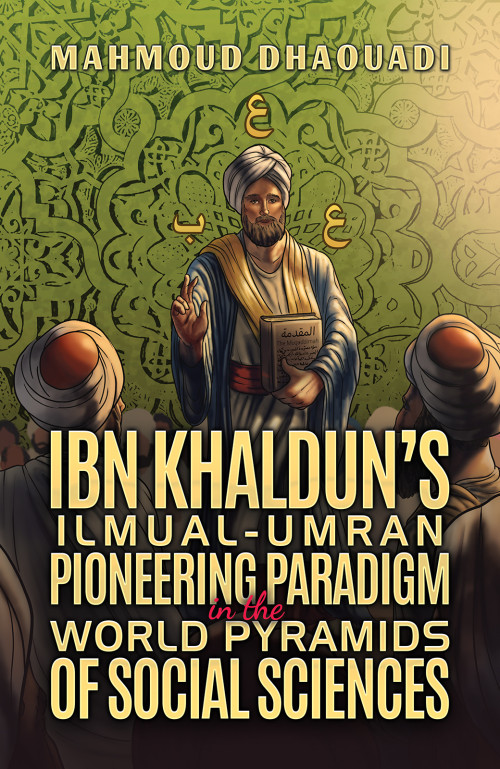
The author of this book has a sociological imagination that has made him consider the huge world volume of social sciences like several pyramids built through the ages, where Ibn Khaldun inaugurated the building of the first pyramid in his famous book, The Muqaddimah. Ibn Khaldun’s innovative social science work is the outcome of multiple factors, among which are his creative personality that allowed him to perceive and capture the dynamics of latent and manifest features of Muslim societies, particularly in North Africa, which other scholars failed to do.
Furthermore, his scholarly vision had set his path to achieve great success in being the social science pioneer in the entire world. He had a critical view of Arab Muslim historiography: Arab and Muslim historians had pitfalls in their methodology and in the analysis of historical events. In the views of Ibn Khaldun and Thomas Kuhn, their works were hardly credible. Thus, there was a pressing need to solve the Arab Muslim historiography’s crisis. The Muqaddimah’s new sociological perspective, according to both Yves Lacoste and Arnold Toynbee, is an exceptional intellectual piece of work. Professor Dhaouadi believes that The Muqaddimah constitutes a new paradigm to meet that crisis.
In Kuhn’s terms, The Muqaddimah sets the pace for reforming the science of Arab Muslim Historiography by shifting from what Kuhn calls normal science to revolutionary science. Ibn Khaldun’s sociological approach is inclusive (it stresses the influence of both latent and manifest factors in shaping society and individual behaviours); he was unlike Positivist contemporary social scientists, who give prominent role to manifest factors. They are rather exclusive social scientists. One may claim that The Muqaddimah has revolutionized the relation between the disciplines of history and sociology in North Africa and the Arab Muslim world by affirming that ‘good historians must be first of all good sociologists.’











 Discover